
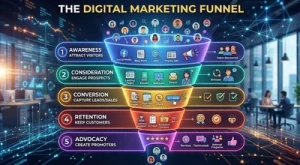
Most businesses lose customers not because their marketing doesn’t work, but because there’s no structured path guiding a stranger from first noticing a brand to actually buying from it. That structured path is the digital marketing funnel, and understanding it is the difference between random campaigns and a system that consistently turns visitors into paying customers. This guide breaks down every stage of the funnel, the tools to track it, and a real campaign example showing exactly how it plays out for an Indian business.
What is the digital marketing funnel?
The digital marketing funnel is a structured process that guides potential customers from initial awareness phase to purchasing phase and beyond through different stages such as awareness, interest, desire, and action. It helps businesses optimize conversions and improve customer journeys and experience.
To build a strong foundation, you should also understand modern strategies, explore leading digital strategies for brands that support the digital marketing funnel.
What is Funnel Marketing
A marketing funnel is a plan that plots a path from brand awareness to purchase decisions and it even goes up to the post purchase stage. This entire journey is known as marketing funnel, which helps businesses understand the stages of the marketing funnel and improve conversions.
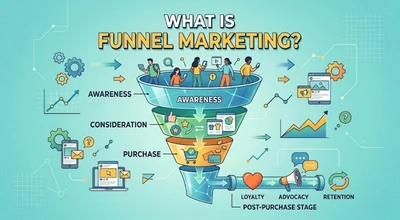
This model provides marketers with detailed insights related to the behaviour and that information gives them guidance on how to close the deal and build relationships with buyers. To put it simply, an online marketing funnel is a strategic way of tracking how your marketing guides potential customers through the buying process within the digital marketing funnel.
Some businesses have simple marketing funnels which is when someone clicks on their ad and makes a purchase, representing the shortest form of marketing funnel stages.
Explore expert digital marketing strategies here: DigiAdGalla
Approaches To Funnel Marketing
- The traditional marketing funnel
- The modern marketing funnel
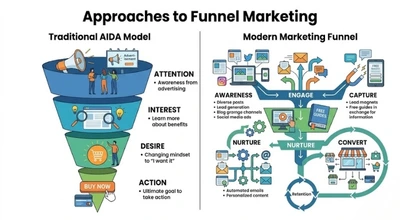
Traditional Marketing Funnel (AIDA)
AIDA is typically used as the foundation for sales and marketing funnels because they are both based on the same theory. It says, consumers go through many stages of the digital marketing funnel before making a final purchase of a product or service.
According to the AIDA principle, a main marketing funnel looks like this:
- Attention: Customers know the brand and its products. Usually, this awareness comes mainly from advertising.
- Interest: Customer interest is growing and potential customers learn more about the benefits they can get from the brand, the products and how it fits their lifestyle.
- Desire: Once the consumer becomes interested in the product or service, the aim is to get the consumer to want it by changing their mindset from “I like it” to “I want it”.
- Action: The ultimate goal is to get the recipient of the marketing campaign to take action and buy the product or service.
Modern Marketing Funnel
- Awareness: This is the highest level in the marketing funnel. A future customer gets to know your company through marketing campaigns. New prospects entered the lead management system.
- Engage: Potential customers learn more about the brand and its products or services. Marketers can take care of leads through email, more industry specific content, brands, newsletters, and more.
- Capture: Potential buyer becomes qualified buyer and can see more activities related to this brand. Companies can send potential customers more product information via automated email while providing them with targeted content.
- Nurture: Potential buyers show interest in buying from your store. An opportunity for businesses to show why their product is the best option for a buyer.
- Convert: Buyers make the final decision whether to buy from you or not.
What is a funnel?
A funnel is the set of steps a visitor needs to go through before they can reach the conversion. Think about the Amazon purchase funnel. There are a few steps a visitor has to go through before they can purchase a product. They have to view a product. They have to add a product to the cart.
For more understanding of the digital marketing funnel, have a look at HubSpot Funnel Guide.
Marketing Versus Sales Funnels
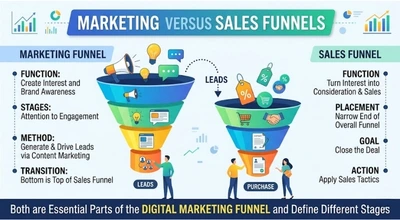
Marketing funnel:
- Its function is to create both interest and brand awareness.
- The bottom of the marketing funnel marks the top of the sales funnel.
- Take customers from attention stage to engagement stage
- Focus on generating and driving leads through content marketing
Sales funnel:
- These are sales strategies that turn customer interest into consideration and ultimately into sales.
- Lie on the narrow end of the conical marketing funnel
- The goal is to close the deal
Shift from sales to marketing
In recent years, the focus has shifted noticeably from sales-led to marketing-led customer acquisition, with marketing now doing far more of the work that sales teams used to handle directly.
Sales teams used to be responsible for educating a buyer from scratch, explaining what a product does, why it matters, and why it is worth the price. Today, most of that education happens before a salesperson ever gets involved, through blog content, social proof, reviews, and search results the buyer finds on their own.
By the time a sales conversation starts, the buyer has often already decided they are interested, which means marketing now carries most of the weight that used to sit entirely with sales.
Why Marketing Funnel Is Important
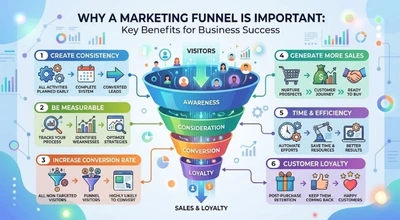
- Create Consistency – All marketing activities in each phase of the digital marketing funnel are planned early and work in a complete system with the ultimate goal of converted leads.
- Be Measurable – The Funnel tracks your process and identifies weaknesses in your marketing and sales systems that are causing you to lose customers. You can therefore twist and change your strategies.
- Increase conversion rate – The funnel filters out all non targeted visitors. With the right marketing strategies, you can limit the number of visitors to your website just to target your ads to those who are most likely to convert.
- Generate more sales – The most important competitive advantage always starts with knowing your customers. With every step of your shopping journey, your needs and desires change. Being able to identify your marketing funnel allows you to take care of buyers until they are ready to buy.
- Time and Efficiency – By planning all activities ahead for each stage of the funnel, you can automate your marketing efforts. You can save a lot of time and resources to get better results
- Customer Loyalty – A post purchase marketing activity plan will help you retain customers and keep them coming back from time to time.
Optimizing your content is essential, learn more in this guide on on-page SEO for beginners to strengthen your funnel performance.
How To Create A Powerful Marketing Funnel
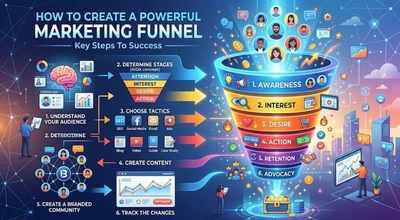
- Understand your audience
- Determine the number of stages in the marketing funnel
- Choose tactics for each step of the funnel
- Create content for each part of the funnel
- Create a branded community
- Track the changes
Understand Your Audience
The first step in building a marketing funnel is to understand your target audience. You need to know who you want to target before you can create a marketing funnel to target and convert them into customers. This step is crucial in building an effective marketing funnel.
There are several ways in which you can understand your target customers. These include direct feedback from your existing customers, surveys, social media, and web analytics data.The idea is to not only understand who your target customers are but also how they interact with your website and content. Their online behaviours will help you understand how to shape your funnel and what stages to add in the digital marketing funnel.
Determine The Number Of Stages In The Marketing Funnel
Once you understand a typical buyer’s journey before purchasing your products, then you can determine the different stages in your funnel. A marketing funnel, after all, is just a way to direct more people in the right direction on their journey.
- Awareness
- Interest
- Desire
- Action
These are the core marketing funnel stages.
Choose Tactics For Each Step Of The Funnel
The next step is to figure out which marketing strategies will be used at each stage. This helps optimize your digital marketing funnel effectively.
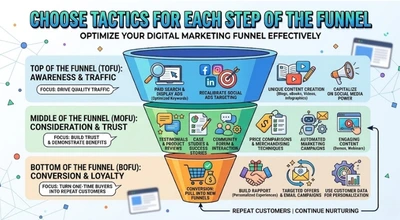
- Top of the funnel
- Middle of the funnel
- Bottom of the funnel
Top Of The Funnel
The traffic you are sending to your online store will largely determine the effectiveness of your conversion path. If you’re generating junk traffic and bringing visitors that have no interest in your products, the stability of the sales funnel won’t matter, as people will drop off immediately.
Focusing on driving quality traffic is the first step to optimizing the upper funnel in the digital marketing funnel, and there are various methods you can test:
- Optimizing your keywords for paid search and display ads
- Adjusting the targeting of your social media ads on Facebook, Instagram, LinkedIn Ads
- Creating unique, keyword optimized content for blog posts, eBooks, guides, infographics, videos, etc.
- Capitalizing on the power of social media
Driving the right audience is crucial, which is why understanding social media marketing is so valuable at this stage.
Middle Of The Funnel
The middle funnel is all about building trust with your buyers and showing the benefits of your products. This stage plays a critical role in building trust before conversion. Depending on how long your conversion path is, you might need a number of different interactions with your customers to earn their loyalty and move them down to the next step of the funnel.
An arrangement of different tools and techniques are at your service here like testimonials, product reviews, case studies, community forum, price comparisons, various merchandising techniques, automated marketing campaigns, engaging content, and so on.
Building trust is critical at this stage, our guide on the importance of trust in branding explains how to build it and improve conversions.
Bottom Of The Funnel
As your leads move down into the last stage of the digital marketing funnel, you need to start pulling them into new conversion funnels. You have done all this hard work guiding them from the awareness stage to the final purchase, letting them go now would be a great loss. E-Commerce businesses that can turn one time buyers into repeat customers are on the right track to success.
The more customer data you have, the more personalized and targeted experiences you can craft to keep them interested and wanting more. Once a lead has converted, pull it back into the nurture phase and continue building relationships through targeted offers and email campaigns. This is the most crucial part of the entire process.
Many businesses fail here, discover why traffic alone never grows a business and how to fix your funnel.
Digital Marketing Funnel Tools
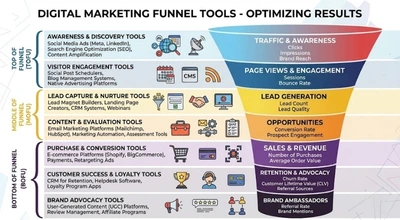
Tools help optimize each stage of the digital marketing funnel and improve results.
Creating Funnel In Google Analytics
The easiest way to start testing your funnel is by setting conversion goals in Google Analytics. Conversion goals are meant to track a customer from the moment they land on your page, to what their actions are, to where they drop off. The data you will find in your Google Analytics funnels will show you exactly where your potential customers are losing interest.
- First, add your website to your Google Analytics page, you will find the relevant tracking code under the “Admin” link.
- After that, you can copy and paste the code on all the pages that make up each part of your funnel.
- To create conversion goals within Google Analytics, click on the section called “Conversions” on the dashboard menu.
- When you click it, you’ll see a sub menu.
Tracking issues can affect your funnel, check out Google indexing issues and fixes to ensure proper visibility.
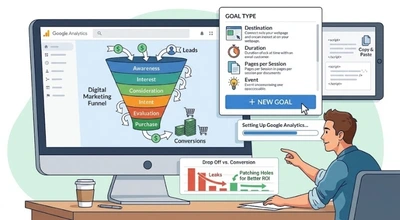
There are a few different types of conversion goals that you can track:
- Destination – Use destination goals to set a page view as a conversion.
- Duration – Set duration goals to measure time on page, and tie that to a conversion goal.
- Pages or screens per session – Setting pages or screens per session as a goal allows you to measure user engagement by observing the number of pages or screens a user views in a single session.
- Event – Set an event goal if you want to set a user interaction on your site as a conversion like signing up for an e-mail list.
To create a New Goal, you can click “New Goal” and go through the steps. Once you have created a goal, you have to create a funnel around that goal within the digital marketing funnel.
After this step, you will be able to add your individual funnel steps from beginning to end. Here’s an example of how a Shopify customer might go through the process of searching for and buying a new pair of shoes.
Finally, you can select “Create Goal” to finish. Now you will be able to measure conversion rates at each stage of your funnel in order to analyse the patterns behind customer drop off. This will better provide you to patch those “holes” and ultimately boost your bottom line.
Analyze Your Landing Pages
Once the funnel is set up and you have started collecting data on some of the pages in your funnel within the digital marketing funnel, it is time to start adjusting different parts of your page to see how you can boost conversions.
Here are a few factors that make a high-converting landing page, according to Kissmetrics. Kissmetrics is a customer analytics and conversion optimization tool that helps businesses track, understand, and improve user behavior on their website
- Clear and concise headlines
- Social proof
- Strong CTAs
- Limit the number of links
Clear Concise Headlines
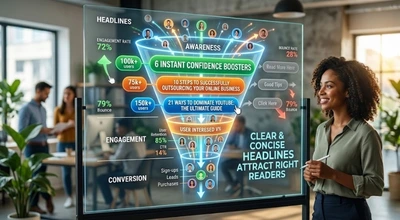
Headlines that address a specific point that’s related to the page’s content will attract the attention of the right type of reader, while unclear headlines cause higher bounce rates. Strong headlines play a key role in the early stages by capturing attention and improving engagement.
Here are some article headlines that headline styles similar to these are widely credited with driving Income Diary’s early traffic growth:
- 6 Instant Confidence Boosters
- 10 Steps to Successfully Outsourcing Your Online Business
- 21 Ways to Dominate YouTube: The Ultimate Guide
Social Proof In Marketing Funnel Stages
One of the best ways to boost conversions in the marketing funnel is through social proof. There are a few different social proof strategies you can use on your landing pages to boost conversions across various stages of the marketing funnel, including:
- Testimonials, ratings or reviews
- Influencer endorsements
- Customer logos
Trust badges: Security certifications or trust badges are very important in the digital marketing funnel. One frequently cited case study on trust badges found that an eyewear retailer saw a meaningful lift in both conversions and revenue per transaction after adding a recognized security seal to their checkout page, a reminder that visible trust signals can move the needle even at the final step.
Strong CTA’s in Marketing Funnel
It should be obvious to your buyers what you want them to do next once they land on your page. Strong CTAs are essential in guiding users toward conversion in the final stage.
If you want expert help building out your funnel, explore our local SEO services guide.
Limit The Number Of Links In Marketing Funnel
The more options people have, the less likely it is that they will choose any of them. On your landing page, limiting the number of links will make it easier for users to take action on the few links that you do have.
For example, notice how Kissmetrics makes it extremely obvious what they want visitors to do once they land on their site.
How the Funnel Actually Works for Indian Brands: A Real Example
The marketing funnel will always look clean on graphs. However, to most businesses, the marketing funnel looks different indeed, and understanding the difference makes all the difference between winning campaigns and losing ones.
Here’s a real funnel we constructed and monitored for a Delhi NCR based home services business over 90 days (client details anonymized for confidentiality):
TOP OF FUNNEL (Awareness): We produced 2 educational YouTube videos per week explaining how to answer the top queries their customers type on Google while considering a home service provider. This top stage of the Digital Marketing Funnel focused on building awareness. Within 60 days these videos were getting 3,200 organic views monthly without spending a single rupee on ads. The audience was unaware of this brand but was watching 4-7 minutes long video content from them.
MIDDLE OF FUNNEL (Consideration): Each video contained a call to action for following their Instagram page, on which we posted their before and after pictures 4 times per week. Out of these YouTube viewers, 8% followed on Instagram, which may sound little but means 256 truly interested people per month.
BOTTOM OF FUNNEL (Conversion): The followers on Instagram were offered story polls and Q&A posts that helped them become familiar. The bio of the Instagram page was linked to the WhatsApp inquiry. This conversion stage of the Digital Marketing Funnel proved highly effective, as out of 256 followers that were generated in a month, 31 people made a WhatsApp inquiry. This means that the follower to inquiry conversion rate was 12%, which is much higher than industry standard 2-4% for cold traffic ads.
RESULT: Total cost of the funnel: ₹12,000 per month for content creation. Inquiries generated in a month: 31. Cost per inquiry: ₹387. The same company used to generate inquiries for ₹920 by using Instagram boost ads without any other stages of funnel. The funnel strategy costs 58% less for inquiries and generates inquiries of higher quality since they had already been consuming content from the brand before making the inquiry.
This is what the funnel is meant for, not just as a concept but as a structure to reduce costs and improve the quality of leads.
Frequently Asked Questions
What is the digital marketing funnel?
The digital marketing funnel is a framework, usually consists of awareness, interest, desire, and action, detailing how a potential customer interacts with your brand all the way from discovery to a purchase. Unlike any other form of marketing, a funnel will ensure that all your efforts are towards helping the customer at each specific step of the purchasing decision journey.
What are the different steps in the marketing funnel?
The classic AIDA framework is made up of Attention, Interest, Desire, and Action. However, the new one mostly used by modern digital marketers is broken down into Awareness, Engage, Capture, Nurture, and Convert, giving finer control over lead look after by using e mail and content marketing.
Why is marketing funnel important for small businesses?
A business without a marketing funnel can only do single campaign marketing, where a customer sees your ad once and has to immediately make a purchase. Marketing funnels give customers time to gain confidence in their decision through several interactions, and this is exactly what the 90 days case study in Delhi NCR proved above, reducing cost per inquiry by 58% using funnel.
What is the difference between sales funnel and marketing funnel?
Marketing funnel includes all processes related to raising awareness and creating interest. Sales funnel starts when marketing funnel ends, warm leads are converted into real customers through sales activity, demo talks or closing calls.
What is TOFU, MOFU, and BOFU?
It stands for Top of Funnel (awareness level content such as videos or blog posts), Middle of Funnel (consideration level content such as case studies and testimonials which create trust) and Bottom of Funnel (action driven content such as limited time offers or free consultations).
How can I optimize my marketing funnel without additional expenses on ads?
First, focus on middle and bottom part of your funnel, most of companies lose customers not due to lack of traffic but because of lack of trust building process before the offer. Usually, including testimonials, case studies and having clear way of conversion like WhatsApp CTA, helps to increase conversion rate more effectively than spending extra money on ads at the top of funnel stage.
Looking for professional help? Check out digital marketing agency in Hauz Khas to implement a high-converting funnel.
Conclusion: Mastering the Marketing Funnel
The marketing funnel is more than just a strategy; it is a complete framework that guides potential customers from awareness to conversion and even post-purchase engagement. Businesses that understand and optimize these marketing funnel stages are able to create better customer experiences, improve conversions, and build long term relationships.
From crafting clear headlines and using social proof to implementing strong CTAs and optimizing landing pages, every element plays a crucial role in strengthening the overall system. Each stage requires a different approach, and when executed correctly, it ensures that no potential customer is lost along the journey.
In today’s competitive digital landscape, simply attracting traffic is not enough. You need a well structured marketing funnel that takes care of leads, builds trust, and drives consistent results at every stage.
If you want to build a high converting funnel for your business, explore expert solutions here: Digital Marketing Services


