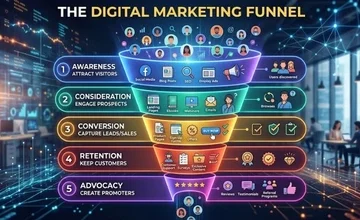
If you have ever sat across from three different agencies, heard three confident pitches, and still had no real way to tell which one would actually grow your business, this guide is for that exact moment.

This guide walks through exactly how to choose a digital marketing agency in 2026, covering the questions that actually separate a good partner from a good pitch, without the generic “ask about their experience” advice you will find on most other lists.
What Does Choosing the Right Agency Actually Involve?
Hiring a digital marketing agency is less like buying a service off a menu and more like hiring a long-term team member, one who will control how your business shows up online for months or years. Getting it right depends less on finding the most polished pitch deck and more on evaluating a handful of concrete things: how they price their work, who legally owns the accounts they manage, how they communicate, and how honestly they talk about results.
The sections below walk through each of these in order, followed by a simple framework you can actually use while comparing quotes.
Why This Decision Is Harder in 2026 Than It Used to Be
Digital marketing changes faster than most business owners have time to track. Search algorithms update constantly, social platforms shift how organic reach works every few months, and AI tools are now reshaping how content gets written and how ads get targeted. An agency that built its entire playbook a few years ago and never updated it is not equipped to compete for your business today.
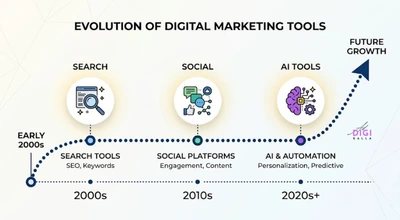
This is also why the market is more crowded than ever, full-service agencies, niche specialists, freelance collectives, and AI-powered platforms are all competing for the same budget, which makes a clear evaluation framework more useful now than it would have been a few years ago.
Step 1: Get Clear on Your Own Goals First
Before contacting a single agency, decide what success actually looks like for your business. More leads, more direct sales, better brand recognition, and stronger local visibility all call for different skill sets, and an agency that is excellent at one is not automatically good at another.
If you are not sure where marketing fits into your broader customer journey, our guide to the digital marketing funnel is a useful starting point before you start comparing agencies.
Step 2: Check Real Portfolio and Case Studies, Not Just Claims
Ask for specific examples of past work, ideally in your industry or a closely related one, and look at what actually changed for that client rather than just the agency’s description of the project. A results page full of vague phrases like “boosted visibility” without any real detail is a weaker signal than a specific, walked-through example.
It also helps to check whether the agency’s own content reflects the standards it claims to deliver for clients. An agency that cannot get its own SEO right, such as understanding what technical SEO actually involves or applying basic on-page SEO fundamentals to its own site, is unlikely to deliver much better for yours.
Step 3: Understand Pricing Models Before You Compare Quotes
Agencies typically price their work in one of three ways: a fixed monthly retainer, a one-time project fee, or a performance-based model tied to results. Each has trade-offs. A retainer gives ongoing, consistent attention but requires trust that the hours are being used well. A project fee is predictable but rarely covers the ongoing work that channels like SEO actually require. A performance-based model sounds appealing but can quietly push an agency toward short-term wins over durable, sustainable growth.
Comparing quotes side by side only works once you understand which model each number is based on, since a lower monthly figure attached to a narrower scope of work is not automatically the better deal.
Step 4: Ask Who Owns Your Accounts and Data
This is one of the most overlooked questions in the entire process, and one of the most important. Ask directly who owns your Google Ads account, your social media profiles, your website, and your analytics data once the relationship ends. Every one of these should belong to your business, not the agency. Google’s own documentation on manager account access levels explains the difference between simply being linked to an account and actually holding administrative ownership of it, which is exactly the distinction worth confirming in writing before you sign anything.
An agency that hesitates on this point, or that structures accounts so that only they retain admin access, is not building a partnership you can safely walk away from later if you need to.
Step 5: Evaluate Communication and Reporting Style
Ask what a typical month of communication actually looks like: a live dashboard, a written report, a recurring call, or some mix of all three. Then ask to see a sample report before you sign anything. A report full of dense jargon and no clear explanation of what happened and why tells you something about how the working relationship will feel six months in.
Culture fit matters here too. You are going to be reviewing this agency’s work regularly, so it is worth paying attention to whether their communication style actually matches how your team prefers to work.
Red Flags That Signal a Bad Fit
A guaranteed ranking, a guaranteed number of leads, or a guaranteed return on ad spend, without any caveats, is one of the clearest warning signs in this entire process. No legitimate agency can honestly promise a specific outcome, since results depend on your industry, your competition, and your starting point, not just the agency’s effort.
Other signs worth watching for include reluctance to share past client results, vague answers about who will actually work on your account day to day, and pressure to sign quickly before you have had time to compare other options.
How to Choose a Digital Marketing Agency: A Simple Decision Framework
Once you have gathered answers from each agency you are considering, compare them against the same five questions side by side: What is their specific plan for your stated goal? What does their pricing model actually include? Who owns the accounts and data once the engagement ends? What does a typical month of communication look like? And do they hedge realistically on timelines and results, or do they promise guarantees no one can actually deliver?
An agency that answers all five clearly and consistently is a far safer bet than one with an impressive pitch but vague answers once you ask specifics.
A Hypothetical Example: Comparing Two Agencies
To make this concrete, here is a hypothetical example based on patterns commonly seen in this kind of evaluation, not a real client case.
Imagine a small business owner comparing two agencies for the same project. Agency A quotes a lower monthly retainer, promises a top-three Google ranking within sixty days, and is vague when asked who owns the Google Ads account once the contract ends. Agency B quotes a slightly higher retainer, explains that meaningful ranking movement typically takes three to six months, and confirms in writing that all accounts stay under the client’s own ownership from day one.
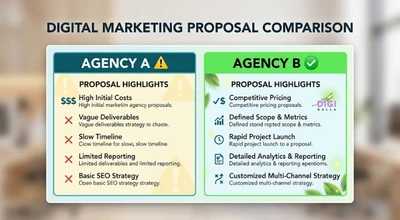
On price alone, Agency A looks like the better deal. Once you apply the framework above, the picture changes, the guaranteed ranking is an unrealistic promise, and losing account ownership could mean rebuilding everything from scratch if the relationship ever ends. This is illustrative only, and every real evaluation should be based on the actual answers a specific agency gives.
Common Mistakes Businesses Make When Hiring an Agency
Choosing based on price alone, without comparing what is actually included in each quote. A cheaper retainer covering half the work is not actually the cheaper option.
Skipping reference checks. A quick call with a current or past client often reveals more than an hour-long pitch meeting.
Assuming bigger automatically means better. A large agency with a long client roster is not automatically a better fit than a smaller team that specializes in your exact industry or city. This is part of why understanding why so many businesses waste their marketing budget matters just as much when hiring an agency as it does when running campaigns yourself.
Frequently Asked Questions
1. How do I choose a digital marketing agency for a small business?
Start by getting clear on one or two specific goals, then compare agencies on pricing model, account ownership, communication style, and how realistically they talk about timelines, rather than on the pitch alone.
2. What questions should I ask a digital marketing agency before hiring them?
At minimum, ask about their pricing model, who owns your accounts and data after the engagement ends, what a typical month of reporting looks like, and how they measure success for a business like yours.
3. How much should a digital marketing agency cost?
Costs vary widely by scope, city, and channel mix, so there is no single right number. What matters more is understanding exactly what is included in a quote before comparing it against another agency’s price.
4. Is it a red flag if an agency guarantees results?
Yes. No legitimate agency can honestly guarantee a specific ranking, lead count, or return on ad spend, since results depend on your market and competition, not just the agency’s effort.
5. Should I choose a specialized agency or a full-service one?
It depends on your goals. A specialized agency often goes deeper on one channel, while a full-service agency can be useful if you need several channels working together under one team.
Final Thoughts
Choosing a digital marketing agency comes down to fewer variables than it feels like in the middle of a pitch meeting: clear goals, an honest pricing model, real ownership of your own accounts, and a team that talks about timelines realistically instead of making guarantees no one can keep.
If you are evaluating agencies for your own business, DigiAdGalla works with businesses across Delhi NCR on SEO, paid media, and social. You can see client testimonials and our full services page, or get in touch directly to talk through what you actually need before comparing quotes.