
If you are learning how to write a blog post, understanding content strategy and structured thinking is the first step toward writing with more confidence and consistency.
To learn more about SEO basics, you can also read our guide on On Page SEO for Beginners.
What is a Blog Post?

A blog post is a piece of content published on a website that provides information, solves problems, or shares insights on a topic. This helps improve your site’s visibility, attract traffic, and build authority over time.
How to write a blog post?
To write a blog post, start with Innovative ideas, conduct keyword research, create a structured draft, write high quality content, and optimize it as per SEO guidelines.
Consistent practice helps you improve your skills over time.
Brainstorming to develop content ideas?
If you don’t know how to write engaging, user-friendly content, it becomes very difficult to generate real sales through that content.
A structured brainstorming approach improves idea clarity and makes the whole writing process feel far less overwhelming.
Consistently coming up with strong content marketing ideas is really challenging. However, what you need is a reliable process for generating genius ideas fast.

Importance of brainstorming process:
Creative ideas rarely just appear on their own, they take deliberate effort to generate.
Setting a good brainstorming process is the best way to never run out of ideas. It achieves the following things:
- It forces you to think about your audience and consider what your audience wants from you.
- It helps you get the creative thoughts coming in your head, producing ideas that you do not think about otherwise.
Write down potential ideas
The first step is to write down all the ideas that you can think of. You can do this on a whiteboard or a post it note, or anything that you can pin up on a wall later so that you have all your ideas in front of your eyes all the time.

Now take something to write on and set a timer for 10 minutes, so that you can write a blog within a good time frame and increase your speed for later projects with time. Now, try to write freely as many ideas as you can think of before the timer runs out.
Don’t worry whether your ideas are good or bad at the moment, just focus on writing them down for now. The goal is simply to get your thoughts out of your head and onto paper.
If you are in doubt with any of your ideas, still write it down. You’ll have time to sort out what’s good and what’s not when you finalize your blog content.
How to rank your ideas
If you wrote your ideas down on sticky notes or a paper, it is now time to paste them on a wall, so, that you have it right in front of your eyes. They can be posted anywhere as long as you or your team can view them easily.
Paste all your ideas on the left side of the wall or white board and to the right, make three columns which are labeled as 1, 2 and 3.
Evaluating your ideas this way helps sharpen your decision-making, a skill that matters as much as the writing itself.
How to score each topic
There are two methods in which you can use them.
Method 1: Read your ideas
- Read all your ideas.
- Then, rank each idea a Good, Bad or Average.
- Place all ideas into its column on the board.
This method works well for teamwork.
The reasons for which we are reading all the ideas out loud are:
- It will motivate you and your team members.
- An idea may seem good when written, but not so much when it is heard out loud.

Method 2: Start scoring your ideas
One person reads each idea aloud, then every team member submits a score reflecting their opinion of it. If you don’t have a team, you’ll need to do this scoring yourself.
The reader then examines all scores and notes them down in a document.
Your team will then be presented with a list of all ideas that have been labelled as Good. You can then decide whether those ideas are good for writing a blog post on them or not.
The strength of this method is that it gives you better feedback.
Narrow down your best content ideas
And now, the last stage of this process is working on the best idea.
Here are some questions you should ask yourself about the idea from the list of ideas:
- What problem would this post solve of the readers? What question would it answer?
- Which approach would be there for this post?
- What could be some good headlines for a particular post from these ideas?
This way, you can work on the idea after finalizing.
Key Indicators for Strong Content Ideas:
Strong Topics are original and unique
We can say that an idea is original if you have never used that particular topic before. If a specific topic is used often in your previous work, then there needs to be a way to use that same thing differently.

Strong Topics Attracts your audience
When you’re new to writing a blog post, you don’t yet know what will interest your audience. But if you notice an ongoing trend of frequent questions, that’s usually a good sign the topic is worth writing about.
Strong Topics Suit your Area of Expertise
Topics you choose have to be related to your brand or company’s work. So if your site is all about food, then a topic on changing your motor oil will not make any sense in that context.
Strong topics should be ones that suit your area of expertise and match what readers expect from you.
Strong topics are those that you do better than others
This relates to the point made earlier regarding remaining within the topic where you have your expertise. To create an effective blog post that will generate traffic from organic search and get talked about on social media, has to be good and unique enough to attract everyone’s attention.
And in fact, it has to be better than any other content on the same or similar topic.
Tips to Make Brainstorming Process Effective
The more you work on this process, the more efficient and effective you will get. You will also find yourself coming up with better ideas with time.
Don’t think, just act
Move ahead with your gut feeling when choosing the final idea. The ideas that get you the most excited right away are usually the ones worth writing about.
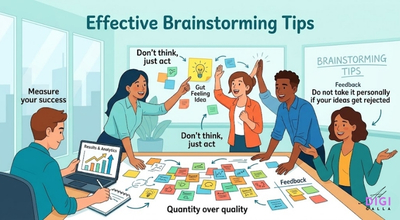
Quantity over quality
Letting yourself write all the ideas that come to your mind helps you be creative. It may even give rise to some ideas that you would not normally come up with.
Measure your success:
When you have posted a few posts by following these methods, be very careful of what works well for you and always rework your content strategy accordingly.
If something does not work out well for you, think about what went wrong.
On the other hand, when something works well, find out what made it work well.
Do not take it personally if your ideas get rejected:
If your idea is rejected, do not take it personally at all. It is just that this whole technique is supposed to help you think of as many ideas as you can in lesser time.
That means many of them will not be chosen.
Validating Topics with Keyword Research:
Now it is time for you to do some keyword research.
This step helps you identify keywords related to your topics that you can use in your blog posts.

Keyword research is an essential and important stage in the process of writing content. It will help you target the right audience and improve your writing skills.
This takes extra time and effort, but it’s essential for making sure your topics actually bring traffic to your site. Perform the following steps to know which of your selected blog topics are the most effective ones:
- Using keyword tools to find similar keywords.
- Copying these keywords into Google Keyword Planner (found inside Google Ads).
- Try searching these keywords on Facebook and Twitter, and observe what kind of discussion is going on around these keywords online.
- Also manually search these keywords on Google too, and analyze the top ten results which appear on SERP.
- Now check if the posts that currently exist on top 10 on SERP for that keyword match the same idea behind your topic.
If you can’t find keywords with high search volume for your topic
You may have a good topic that your target audience will enjoy, but does not align with keywords that have good search volume. Is this the reason you should leave a great idea? No, definitely not.
Creating a blog post without a good search volume is always risky. You will waste a lot of efforts, time and resources to promote it online through social media and emails, but you will not be able to attract any organic search traffic. However, it is possible that your idea does not get a lot of searches because it answers a question people do not know they should ask.
In this case, it is better to link your topic to some popular keywords.
Experimenting with ideas even without high search volume helps you develop unique content strategies and experience over time.
Struggling to find Good keywords?
There are a few ways which you can use:
Ask your social media audience:
If your audience engages and responds, that’s a strong signal the topic is worth writing about.

Look for Related Keywords:
Do some keyword searches for similar topics related to your selected topic. It is even possible that this give you more thoughts and new ideas related to your target audience’s preferences.
Use HubSpot’s Blog Ideas Generator:
Enter a few terms related to your chosen topic, and it will generate blog title suggestions instantly.
Powerful Keyword Research Tools
Keyword research is an essential part of SEO. Whether you are updating an old blog or developing your content strategy for a new one. Good quality keywords are essential to attract consistent and reliable traffic to your site.
- SEMrush
- Ahrefs keyword explorer
- Google Keyword Planner
- KWFinder
- GrowthBar
- Long Tail Pro
- Majestic
- Keyword Tool
- Serpstat
- Moz keyword explorer
- SpyFu
For Google’s own perspective on how to think about the words people search for, see the SEO Starter Guide from Google Search Central.
You can explore our detailed guide on Local SEO Services to understand how keywords impact rankings.
How to Improve your Writing
Practice makes perfect.
You need to practice regularly and in ways that work for you.
Content writing is not an easy process or something that requires less time, it’s a long and time consuming process.

As a content writer you need to come up with ideas every minute.
To train your mind in coming up with creative and better ideas, follow the steps below :
- Know your readers or audience
- Always ask your audience and take their opinions
- Use research tools
- Look at your past blog responses and analyse it
- Keep yourself up to date with market trends
- Learn from other content writers by seeing their work, get inspired by their work. Do not steal their ideas.
Make sure the blog’s headlines and titles are :
- Written in a way that makes someone want to click and read.
- Easy to read and understand and clearly framed.
- Google ranking friendly as per SEO guidelines
Do’s and Don’ts of content writing
You need a high quality content to rank your blog post on Google, increase traffic and bring conversions for your clients.
Look at the Do’s and Don’ts of content writing:

Do’s
1. Always write a unique content
It is difficult to write completely unique content nowadays, but it’s not impossible. Look at the topic from a different angle, or offer genuinely new, first-hand advice. Always trust our experience and brain. Google and audience will reward you for that.
2. Create long contents
Google has no official minimum word count required to rank a page, this is a common misconception. What matters is whether the content thoroughly answers the searcher’s question. That said, in practice, thin content (a few hundred words) often struggles to rank for competitive topics simply because it can’t cover the topic as thoroughly as longer, more complete content can. For competitive topics, content in the 1,600 to 3,000 word range tends to rank better on average, not because of the word count itself, but because longer content usually covers a topic more thoroughly, which is what Google’s ranking systems actually reward.
3. Keep your content Focussed
When you write an article or a content, you must research the topic thoroughly and then keep it focused. If you skip from one topic to another, Google can get confused about what your page is actually about, which dilutes your relevance for any single keyword.
The more broad and unrelated those keywords are, the lower will be the score that you get for each one of them.
Run a deep keyword analysis before writing it, and avoid keyword cannibalization as well.
4. Write for your target audience
It is important to create content that attracts specifically to your target audience.
Conduct thorough research on your target audience to understand their needs and requirements. Make sure you understand their concerns and pain points. This will allow you to choose the right topics and write the most attractive content.
5. Use bullets and numbers
Modern readers rarely read line by line, most have a short attention span and scan instead. Because of this, they prefer content that is easy to scan.
In order to make your content more attractive to them, make sure your content has:
- H1 and H2 headlines
- Subheadings in bold
- Bullet points wherever you can
- Highlighted keywords and phrases
- Numbers and facts wherever possible
6. Practice content writing
You must have heard that “Practice makes perfect”, similarly content writing requires practice. You have already taken the first step in improving your writing as you are reading this right now.
The next step is to write a few practice blog posts, and send them to someone for feedback. Never shy away from listening to feedback either.
Don’ts
1. Never repeat yourself
Your content should always be interesting, fresh and creative. Don’t just repeat what other people are saying or writing. The best writing is authentic and brings a new perspective to readers. Think about what you have shared in the past, and why you and your readers found it useful.
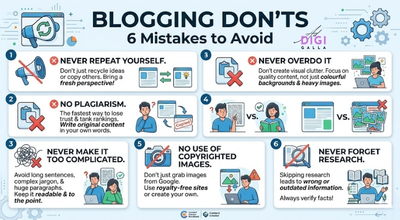
2. No Plagiarism
It is the most important rule of content creation. Plagiarism is the fastest way to lose both audience trust and search rankings. Google and other search engines hate duplicated and copied content and never let them rank on SERP.
Algorithm updates like Panda are created to avoid this copied content problem.
It’s not enough to just avoid copied content, you need to avoid rephrasing content as well. Just changing the order of words and structure of sentences won’t work. You need to understand all the information during research and write your own content in your own words.
3. Never make it too complicated
Complex terms, long sentences, and dense paragraphs make for a poor reading experience. Most audiences online will only scan the content. They do not want to spend too much time on just one article.
Keep the paragraphs and sentences short. Make sure the content is readable and to the point. It is also a good idea to use a larger font that is easier to read instead of something very small. If you enhance the reading experience, more people will be drawn to your content because it’s easy to read.
4. Never overdo it
Graphics are great, but when there are too many, your blog will be like a collage decorations. It will look tacky. Do not forget that some of your clients may not have the fastest internet speeds, and a website that takes too long to load because of too many images will end up losing good customers who won’t come back.
Focus on the writing itself, not on decorative visuals for their own sake. Attract people with your content, not just pictures.
5. No use of copyrighted images
This is a very common mistake and can place website at risk. It is easy to perform a Google search to find images for your content but unfortunately, many of these images are copyrighted and require either permission or full credit.
The best way to avoid this is by creating your own images and graphics. This can be a bit expensive if outsourced to someone and time consuming if done on your own. The other alternative is to use stock images. Pixabay and Pxhere offer genuinely free images with minimal restrictions. Adobe Stock and Shutterstock are premium paid services with larger, higher-quality libraries if your budget allows for a subscription or per-image license.
6. Never forget research:
Some content creators forget research work because they think that they understand the topic well. Unfortunately, this is not a good idea and can lead to wrong information.
Consider research work an opportunity to enhance your knowledge while ensuring your audience gets the most accurate information. Without research, you might provide wrong or outdated information.
SEO Best Practices for Writing a Blog Post
Place your focus keyword naturally in the title, opening paragraph, and one or two subheadings. Use related terms and LSIs instead of repeating the exact phrase, Google’s systems understand context and meaning beyond exact keyword matches.
Avoid keyword stuffing and repeating the same phrase awkwardly to hit a limit that reduce rankings according to Google’s spam policies, rather than helping you rank.
You may also find our insights on Digital Marketing Strategies helpful for improving overall content performance.
Frequently Asked Questions (FAQs)
These frequently asked questions will help you better understand how to write content and improve your content writing skills.
1. How to write a blog post for beginners?
To write a blog post as a beginner, start with simple topic research, create an outline, and focus on writing clear and engaging content. Following this process consistently is really what turns beginners into confident writers over time.
2. How can I become a better writer?
You can become a better writer by practicing regularly, reading quality content, analyzing successful blogs, and applying SEO techniques. Over time, these habits compound, and improvement happens almost without noticing it.
3. What is the ideal length of a blog post for SEO?
There is no universally ideal word count for SEO. What matters is whether your content thoroughly covers the topic and answers the reader’s question. In practice, competitive topics tend to be covered more thoroughly in longer posts (1,600–3,000 words), but thin long form content will always underperform genuinely useful short content. Write as much as the topic needs, not more. Quality matters more than length, always.
4. Why is keyword research important in blog writing?
Keyword research helps you understand what users are searching for. It ensures your content ranks better and reaches the right audience when you learn to write a blog post.
5. How often should I publish blog posts?
Consistency is key. Publishing 1–2 high-quality blog posts per week can help you grow faster without burning out or sacrificing quality.
6. Can I write a blog post without SEO?
Yes, but it may not rank well. SEO helps your content reach a wider audience and is one of the most overlooked skills for new writers to learn early.
Quick Checklist for Writing a Blog Post
- Choose a clear topic
- Do keyword research
- Create an outline
- Write valuable content
- Optimize for SEO
- Use headings and bullet points
- Add internal and external links
Following this checklist will help you build strong writing habits over time.
Conclusion

Writing high-quality content requires strategy, creativity, and consistency. Once you understand how to write content, you can create content that not only engages readers but also ranks well on search engines.
From brainstorming ideas to keyword research and content optimization, every step plays a crucial role in your success.
Whether you’re just starting out or looking to refine your existing skills, continuous learning and practice will always set you apart. Focus on delivering value, stay consistent, and keep improving your process. Over time, you’ll not only build authority but also drive consistent traffic through your blog content.
If you want expert help in content writing, SEO, or digital marketing, feel free to connect with our team at DigiAdGalla and take your content strategy to the next level.