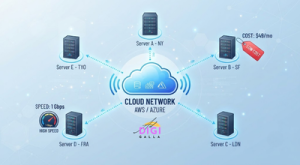
Cloud hosting covers an unusually wide range of products, from a $4 developer VPS to a five-figure enterprise AWS bill, and most “best cloud hosting” lists blur that range together instead of being clear about which end a given provider actually sits on.
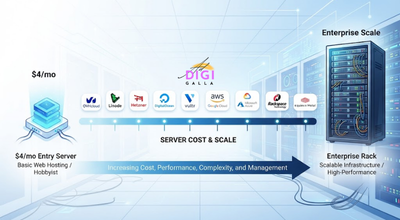
This guide compares five of the best cloud hosting providers in 2026, what each one actually costs, and which end of that range each one is really built for, with every specific price sourced.
Why Cloud Hosting Reviews Rarely Compare Like for Like
“Cloud hosting” covers at least three genuinely different products: raw, unmanaged cloud servers you configure yourself, managed cloud hosting where someone else handles the server for you, and full hyperscaler platforms like AWS with hundreds of separate services. Comparing a $4 unmanaged DigitalOcean Droplet directly against a fully managed Hostinger Cloud plan on price alone misses that they are not solving the same problem.
This guide keeps that distinction explicit for each provider below, so you can compare within the category that actually matches what you are trying to do.
What to Look For Before You Compare Any Provider
Before comparing specific providers, get clear on three things: whether you want to manage the server yourself or have someone else handle it, roughly how much traffic or compute you actually need, and how much budget unpredictability you can tolerate, since several of these providers price cleanly on paper but add real costs through backups, bandwidth overages, and add-ons.
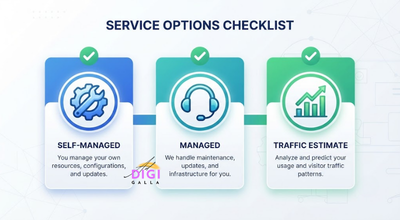
It also helps to check what is genuinely included versus billed separately, backups, bandwidth, snapshots, and support tiers are common places where an advertised entry price and your real monthly bill diverge.
DigitalOcean: Best for Developers and Startups
DigitalOcean’s Basic Droplets start at $4 a month for a 512MB shared-CPU instance with 10GB of SSD storage, with more realistically usable configurations at $6 a month for 1GB of RAM and $12 a month for 2GB, according to DigitalOcean’s own official pricing documentation. As of January 2026, Droplets bill per second rather than per hour, with a monthly cap so a continuously running server never exceeds its listed monthly price.
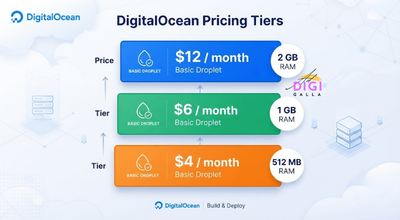
This is an unmanaged product, you are responsible for installing and securing your own software stack, which makes DigitalOcean a strong fit for developers and technically comfortable small teams rather than someone wanting a fully hands-off setup. Worth budgeting for separately: automated backups add 20% of a Droplet’s monthly price.
Vultr: Best for Global Reach on a Budget
Vultr’s entry Cloud Compute plan is priced at $2.50 a month for an IPv6-only instance in limited regions, with a more broadly usable 1GB plan at $5 a month and a High Performance 1GB tier at $6 a month, according to pricing confirmed across Vultr’s own published rates and independent tracking by OneDollarVPS. Vultr operates 32 data centers across 19 countries, according to independent infrastructure tracking by CheckThat.ai, a genuine advantage if you need a server location a smaller competitor does not cover.
Vultr’s own reported customer satisfaction is notably split by audience, CheckThat.ai’s research found a 1.8 out of 5 Trustpilot rating from 541 reviews, largely driven by general consumer frustration, while G2’s more technical, developer-heavy reviewer base rates it considerably higher at 4.3 out of 5. This split is worth knowing, Vultr’s DIY, unmanaged model rewards technical users and frustrates people expecting hands-held support. As with DigitalOcean, backups (20% of the instance price) and DDoS protection are billed as separate add-ons rather than included by default.
Hostinger Cloud: Best for Beginners and WordPress Sites
Hostinger’s Cloud Startup plan costs $383.52 for a 48-month term, working out to $7.99 a month, and renews at $25.99 a month once the term ends, based on the same figures we verified directly against Hostinger’s own pricing page for our full Hostinger review, which covers the pricing and renewal structure in more depth.
Unlike DigitalOcean and Vultr, this is a managed product built specifically around WordPress and general website hosting rather than raw compute, which makes it the most beginner-friendly option on this list, at the cost of the same renewal price jump we covered in detail in that review.
Cloudways: Best Managed Layer on Top of Other Clouds
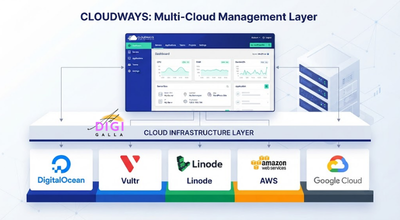
Cloudways is a managed hosting layer that runs on top of DigitalOcean, Vultr, Linode, AWS, or Google Cloud, letting you get a managed experience, backups, staging, a support team, without configuring the underlying server yourself. Entry pricing for its DigitalOcean-based plans has been reported at figures ranging from $11 to $14 a month across sources checked for this post, according to Cloudways’ own official pricing page, which is worth checking directly since Cloudways runs frequent promotional pricing that can shift the advertised entry number.
Cloudways bills hourly with no long-term contract, and importantly, unlike Hostinger and many traditional hosts, multiple sources note it does not apply a steep renewal price increase, the price you sign up at generally stays consistent over time. AWS and Google Cloud plans through Cloudways run considerably higher, commonly cited in the $20 to $38 a month range for entry configurations, reflecting the underlying cloud provider’s own higher base cost.
AWS: Best for Complex, Enterprise-Scale Workloads
Amazon Web Services remains the most comprehensive cloud platform available, offering hundreds of individual services beyond basic hosting, and it is the default choice for enterprises and technically complex, large-scale workloads. Its pricing model is a genuine outlier on this list, rather than a small number of clear tiers, AWS prices most services on granular, usage-based rates that make a simple “starting price” fundamentally less meaningful than it is for the other providers here.
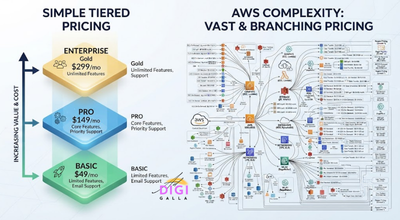
For a small business or a straightforward website, this complexity is usually not worth taking on, the other four providers on this list solve that problem more directly and predictably. AWS earns its place here specifically for teams that need its breadth of specific services, machine learning infrastructure, complex multi-region deployments, deep enterprise integrations, rather than as a general recommendation for most small sites.
Best Cloud Hosting: A Side-by-Side Snapshot
If you are choosing quickly, the shorthand version looks like this: pick DigitalOcean if you are a developer who wants full control at a low starting price, Vultr if global data center coverage matters and you are comfortable with a DIY setup, Hostinger Cloud if you want a fully managed, beginner-friendly option and are willing to budget for its renewal price, Cloudways if you want managed hosting without picking between cloud providers, and AWS only if your workload genuinely needs its scale and service breadth.
None of these is objectively the best cloud hosting provider in every case, and given how much these products differ in what they actually manage for you, the right choice depends far more on your technical comfort than on the sticker price alone.
A Hypothetical Example: Choosing Cloud Hosting as a Project Grows
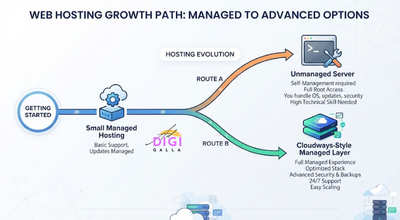
To make this concrete, here is a hypothetical example based on patterns commonly seen in this kind of decision, not a real client case.
Imagine a small business launching its first website with no in-house developer, wanting something reliable without managing server configuration themselves. A business in this position would typically start with a fully managed option like Hostinger Cloud rather than an unmanaged provider like DigitalOcean or Vultr, since the value of not having to configure and secure a server outweighs the lower headline price of a raw VPS at this stage.
A team following this kind of approach would typically only consider moving to an unmanaged provider or Cloudways once they either hire technical staff or hit a specific limitation, a need for custom server configuration, multiple environments, or cost optimization at meaningfully higher traffic, rather than switching providers before that need is actually concrete. This is illustrative only, and the right starting point depends on your own team’s technical capacity and budget.
Common Mistakes When Buying Cloud Hosting
Comparing an unmanaged provider’s price directly against a managed one. As covered throughout this guide, a $4 DigitalOcean Droplet and a $7.99 Hostinger Cloud plan are not the same product, one requires you to configure and secure the server yourself.
Ignoring backup and bandwidth costs until the bill arrives. Several unmanaged providers price backups and overage bandwidth as separate line items rather than including them, budget for these upfront rather than being surprised later.
Choosing AWS or Google Cloud by default for a simple site. Their scale and service breadth genuinely matter for complex, enterprise workloads, but for a straightforward small business website, that complexity usually adds cost and setup time without a corresponding benefit.
Frequently Asked Questions
- What is the best cloud hosting provider for a small business in 2026?
There is no single best option for every business. Hostinger Cloud suits beginners wanting a fully managed, WordPress-friendly option, Cloudways suits businesses wanting managed hosting with more provider flexibility, and DigitalOcean or Vultr suit technically comfortable teams wanting more direct control at a lower price.
- Is cloud hosting more expensive than shared hosting?
Entry-level cloud hosting can be priced similarly to shared hosting, DigitalOcean and Vultr both start under $5 a month, though a genuinely managed cloud product like Hostinger Cloud or Cloudways typically costs more than basic shared hosting once you account for the added management and resources.
- What is the difference between managed and unmanaged cloud hosting?
Unmanaged cloud hosting, like a standard DigitalOcean or Vultr instance, gives you a blank server you configure and secure yourself. Managed cloud hosting, like Hostinger Cloud or Cloudways, handles server setup, security, and maintenance for you at a higher price point.
- Is AWS overkill for a small business website?
For most straightforward small business sites, yes. AWS’s real strength is its breadth of services and scale for complex workloads, which usually adds unnecessary cost and setup complexity for a simple website compared to the other providers on this list.
- Does cloud hosting pricing increase sharply at renewal like shared hosting often does?
It depends on the provider. Hostinger Cloud follows a similar renewal jump pattern to its shared hosting plans, as covered in our full review, while providers like Cloudways, DigitalOcean, and Vultr generally keep pricing consistent over time without a steep renewal increase.
Final Thoughts
The best cloud hosting provider is rarely the cheapest headline number. It is the one that matches how much server management you actually want to take on, with a total cost, including backups, bandwidth, and any renewal pricing, that you have genuinely budgeted for rather than just glanced at.
If you want help choosing and setting up cloud hosting for your business, DigiAdGalla works with businesses across Delhi NCR on the full technical setup alongside SEO and content. You can see our website development services or get in touch to talk through what your site actually needs.