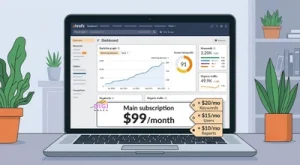
Ahrefs has one of the most respected backlink databases in SEO, and also one of the more misleading homepage prices, the $129 a month you see advertised is rarely the number you actually end up paying once add-ons and seats enter the picture.
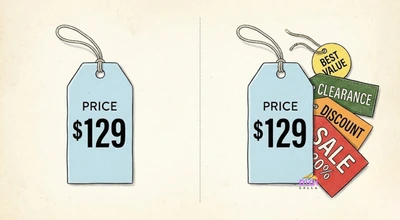
This Ahrefs review covers what you actually pay across every tier, what the free tools genuinely offer, and who the platform actually fits, with every figure sourced.
Quick Verdict: Who Ahrefs Actually Fits
Ahrefs is a strong fit for SEO professionals, agencies, and content teams who need genuinely deep backlink and keyword data and are prepared to budget for both the subscription and its add-ons. It is a weaker fit for a solo blogger or a very early-stage small business mainly wanting a quick, occasional check, where the free tools or a cheaper alternative cover most of what you actually need.
If you are still comparing SEO platforms generally rather than specifically evaluating Ahrefs, our beginner SEO tools guide and our Semrush review both cover where Ahrefs fits into the broader picture, including how it compares against free and lower-cost starting points before you commit to a paid platform at this price level.
Ahrefs Pricing: What You Actually Pay
Ahrefs runs five pricing tiers as of 2026. Starter is priced at $29 a month, billed monthly only with no annual discount option, according to ClaroRank’s pricing breakdown, verified directly against Ahrefs’ own pricing page in July 2026. Lite costs $129 a month on monthly billing, dropping to roughly $108 to $117 a month with annual billing, a savings of around 17%, a pattern confirmed consistently across ThatMarketingBuddy’s Ahrefs pricing tracker as well.
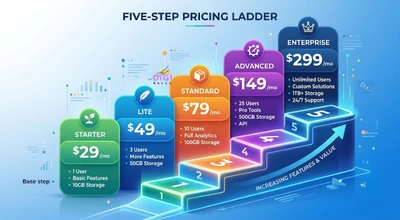
Standard is priced at $249 a month, Advanced at $449 a month, both confirmed across multiple independent trackers checked for this review. Enterprise is listed at $1,499 a month with a required annual commitment, roughly $17,988 a year at that rate, though larger contracts with higher usage needs are negotiated individually beyond this published starting point, according to pricing verified directly against Ahrefs’ own live pricing page.
One important piece of context: these prices are not where Ahrefs started. According to SearchAtlas’s detailed pricing history, Ahrefs has raised prices significantly at least once in recent years, with Lite rising roughly 30% and Enterprise rising up to 50%, while simultaneously shifting from unlimited usage to a credit-based system on lower tiers.
The exact timing of these increases is reported inconsistently across independent pricing trackers, some cite 2023, others 2024, so treat the year itself as less certain than the underlying pattern, prices have risen meaningfully and the shift to credit-based usage is well corroborated regardless of exact date. If you are working from an older quote or a colleague’s memory of what Ahrefs used to cost, it is worth treating that number as outdated.
Ahrefs by Use Case: Where It Actually Earns Its Price
Not every part of Ahrefs delivers equal value for every kind of user, and it is worth being specific about which use cases genuinely justify the cost.
Link building and digital PR is arguably where Ahrefs’ backlink index earns its reputation most clearly. Being able to see exactly which pages link to a competitor, filter by authority and relevance, and track new and lost links over time gives link-building work a level of precision that free tools simply cannot match at scale. This is also the use case most dependent on Standard tier or above, since Content Explorer, excluded from Lite, is central to finding genuine link-building and guest-posting opportunities efficiently.
Content and keyword research benefits from Keywords Explorer’s depth, search volume data, keyword difficulty scoring, and a large database of related terms and questions, though several competitors offer broadly comparable keyword data at this point, meaning this specific use case alone may not justify Ahrefs over a cheaper alternative if it is your only real need.
Technical SEO audits are handled by Site Audit, which crawls a site and flags a wide range of technical issues, from broken links to Core Web Vitals concerns. This tool genuinely stands on its own merit and is often cited as one of the more thorough automated audit tools available, useful even for a team that primarily uses a different platform for keyword and backlink work.
Rank tracking is included across all paid tiers, though the number of keywords you can track scales tightly with your plan, a genuine constraint worth mapping against your actual tracking needs before choosing a tier, since upgrading purely because you have run out of tracked keyword slots is a common, avoidable reason to end up paying for a higher tier than your other needs actually require.
The Free Tools: What’s Actually Free
Ahrefs offers two genuinely different free options, and it is worth being clear about which one you are actually using. The no-account backlink checker, which we covered in more detail in our free backlinks checker roundup, shows up to 100 backlinks for any domain with no signup required. Separately, Ahrefs Webmaster Tools requires verifying ownership of a specific site and gives broader, though still limited, access to Site Explorer and Site Audit for that one verified site.
Ahrefs does not offer a traditional free trial of its paid plans, according to RankMax’s hands-on review, the previous $7, seven-day paid trial was discontinued. If you want to properly test the paid platform’s actual data quality before committing to Lite or higher, the $29 Starter plan is effectively the lowest-risk way to do that, since there is no trial and no money-back guarantee once you subscribe.
What You Get on Each Paid Plan
Starter, at $29 a month, is positioned as an entry point for testing Ahrefs’ data quality on a smaller scale before committing to a higher tier, rather than a plan built for serious, ongoing professional use.
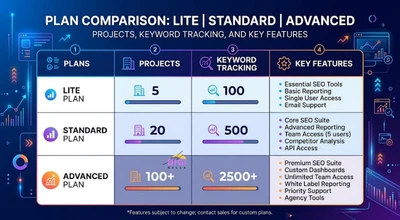
Lite, at $129 a month, supports up to 5 projects, 6 months of historical data, 500 credits a month, and tracking for up to 750 keywords, according to MadX Digital’s feature breakdown. It includes Site Explorer, Keywords Explorer, and Site Audit, but notably excludes Content Explorer, the link-prospecting tool many SEO professionals consider essential, which only unlocks starting at Standard.

Standard, at $249 a month, removes the credit-based restrictions that limit Lite, expands to 20 projects, and adds Content Explorer along with Portfolios and a meaningfully higher tracked-keyword allowance. Several reviewers specifically identify Standard, not Lite, as the realistic starting point for anyone doing serious professional SEO work, since Lite’s missing Content Explorer is a real gap for link-building and content research specifically.
Advanced and Enterprise scale further in projects, tracked keywords, and API access, aimed at larger agencies and organizations managing many client accounts or sites simultaneously. API v3 access, which provides programmatic access to backlink data, keyword metrics, and rank tracking data, is included from Lite upward, with usage limits scaling by tier, 25,000 units on Lite, 150,000 on Standard, 500,000 on Advanced, and 2,000,000 on Enterprise, a level of API access that has become more accessible to smaller teams on lower tiers than it once was.
Key Features Worth Knowing About
Ahrefs’ core strength remains its backlink index, which its own official statistics page reports at more than 35 trillion known links across over 231 billion indexed pages, according to figures reported by SaaSPricePulse’s Ahrefs tracker. This scale is the technical foundation behind nearly every major tool in the platform, Site Explorer, Keywords Explorer, Content Explorer, Rank Tracker, and Site Audit all draw from the same underlying dataset, and the crawler behind it recrawls the web continuously rather than on a fixed, infrequent schedule, which matters when you need to know about a new or lost backlink quickly rather than weeks after it happened.
Domain Rating, Ahrefs’ proprietary metric measuring the strength of a site’s backlink profile on a 0 to 100 logarithmic scale, remains one of the most widely referenced authority metrics in the SEO industry, useful for quick comparisons but, as with any third-party score, not something Google itself actually uses, worth treating as directional rather than a precise ranking predictor. The logarithmic scale specifically means the difference between a DR of 10 and DR 20 represents a much smaller real gap in backlink strength than the difference between DR 80 and DR 90, a nuance worth understanding before comparing two sites purely by their raw DR number.
Traffic estimates, another commonly referenced Ahrefs metric, are worth a similar dose of caution. According to RankMax’s hands-on comparison against Google Analytics data, Ahrefs’ traffic estimates can differ from actual analytics figures by 20 to 50% for smaller sites specifically, which makes the metric considerably more useful for comparative analysis, your site against a competitor’s, than for treating the absolute number as an exact prediction of real visitor volume.
Ahrefs has also expanded meaningfully into newer territory over the past couple of years, adding AI keyword suggestions, AI content grading, and Brand Radar, an AI visibility tracking feature that monitors how often a brand gets cited across AI-driven search tools including ChatGPT and Google’s AI-generated results, moving into ground that was traditionally more associated with Semrush. This expansion reflects a broader shift across the SEO tools industry, as AI-driven search results increasingly sit alongside traditional rankings, and it is a genuinely useful addition for a brand that wants visibility into this newer layer of search behavior without subscribing to a fully separate, dedicated AI-tracking tool.
The Add-On Problem: Why Your Real Bill Runs Higher
This is the single most important thing to understand before subscribing, and the part most homepage pricing comparisons leave out entirely. Several genuinely useful Ahrefs features sit behind separate, additional charges on top of your base subscription.
Report Builder costs $99 a month for 50 scheduled reports, since base plans only include 5 to 25 depending on tier. Project Boost Pro, which enables always-on site audits and instant recrawling, costs $20 a month per project, while Project Boost Max runs $200 a month per project.
Brand Radar AI visibility tracking costs $199 a month for 83 prompts a day and 2,500 checks a month, with extra checks billed separately, according to CheckThat.ai’s detailed add-on cost breakdown. Additional user seats cost another $20 to $100 a month depending on tier and seat type.
This is not a hypothetical concern, it shows up directly in user feedback. A Trustpilot reviewer quoted by that same CheckThat.ai breakdown warned that with these extra charges factored in, real subscription costs run 20 to 40% higher than the advertised base price, and a Capterra reviewer specifically called the per-module pricing model the platform’s single biggest point of criticism.
This pattern of criticism is worth taking seriously precisely because it comes from actual paying customers rather than a competitor’s marketing content, and it is consistent enough across review platforms that it does not read as an isolated complaint. Budget for this explicitly rather than assuming the tier price is your full bill.
The practical way to avoid an unpleasant surprise here is to map your actual, specific needs against the add-on list before subscribing, rather than after. If your work genuinely requires frequent client-facing reports, Report Builder’s cost is a legitimate, planned expense. If you rarely need scheduled reporting, it is worth confirming your base plan’s included report allowance covers your actual usage before assuming you will need the add-on at all. The same logic applies to Project Boost and Brand Radar, both are genuinely useful for the specific workflows they serve, but neither is something every subscriber needs, and treating them as optional rather than assumed defaults keeps your real monthly cost closer to the advertised tier price.
Ease of Use and the Learning Curve
Ahrefs’ interface is generally considered more approachable than some competitors for a first-time user, largely because its tools map fairly intuitively to specific tasks, Site Explorer for backlink and traffic research, Keywords Explorer for keyword data, Site Audit for technical issues, rather than one dense, all-purpose dashboard. That said, getting real value out of the platform still takes real time, understanding how to actually use Content Explorer for link prospecting, or how to interpret Domain Rating alongside more specific metrics, is a genuine skill that builds with use rather than something obvious from the first login.
Ahrefs Review: Genuine Pros and Cons
Pros:
- Genuinely extensive, frequently refreshed backlink index, among the largest available in any commercial SEO tool, with continuous rather than periodic recrawling
- Broad, well-integrated feature set spanning keyword research, technical audits, backlink analysis, and rank tracking, all pulling from one consistent underlying dataset
- The $29 Starter plan offers a genuinely lower-risk way to test data quality before committing to a pricier tier
- Brand Radar gives a real, current option for AI visibility tracking as search behavior shifts toward AI-generated results
- Site Audit is widely regarded as one of the more thorough automated technical audit tools available, useful even alongside a different primary platform
Cons:
- Pricing has risen sharply and repeatedly, up to 50% on some tiers, with no clear sign that trend has fully stabilized
- The credit-based system on lower tiers, introduced alongside the recent price increase, makes entry-level access feel restrictive compared to the platform’s earlier unlimited-usage model
- Add-ons genuinely inflate the real cost, 20 to 40% above the advertised price according to user-reported figures, which undermines the simplicity of the headline pricing
- No free trial and no money-back guarantee, a genuine risk factor for anyone unsure whether the platform fits their workflow before paying
- Traffic estimates can diverge meaningfully, 20 to 50% for smaller sites, from actual analytics data, limiting how much weight to place on the absolute numbers
How Ahrefs Compares to Semrush and Other Alternatives
Against Semrush, which we cover in detail in our Semrush review, the two platforms sit in a broadly similar price range at comparable tiers, and the meaningful difference is less about overall quality and more about where each platform’s core strength lies. Ahrefs has traditionally been seen as the stronger choice specifically for backlink data depth, while Semrush leans toward a broader marketing toolkit spanning content, PPC research, and social tools alongside SEO. Both platforms have also converged somewhat in recent years, each adding AI visibility tracking as a response to the same shift in how search behavior is changing, so this particular gap between them has narrowed compared to a few years ago.
Against lower-cost alternatives, Ahrefs’ core advantage is the scale and freshness of its backlink index rather than being the cheapest option at a given feature level, which is worth being honest about if budget, rather than data depth specifically, is your primary constraint. A tool like Moz or a more budget-focused platform can cover basic keyword and site-audit needs at a meaningfully lower price, though generally with a smaller, less frequently refreshed backlink index than Ahrefs offers.
The practical decision point for most small businesses and solo professionals comes down to a simple question worth answering honestly before subscribing to any paid tier: do you need genuinely deep, current backlink data for competitive research and link building specifically, or would a combination of free tools and occasional spot-checks actually cover your real, ongoing workflow. Ahrefs earns its price for the former use case far more convincingly than the latter.
A Hypothetical Example: Choosing the Right Starting Tier
To make this concrete, here is a hypothetical example based on patterns commonly seen in this kind of decision, not a real client case.
Imagine a small marketing agency evaluating Ahrefs for the first time, currently relying on free tools and a cheaper single-purpose rank tracker. A team in this position would typically start with the $29 Starter plan specifically to test Ahrefs’ data quality and interface against their existing workflow for a month, rather than committing directly to Lite or Standard based on the feature list alone.
A team following this kind of approach would typically only upgrade to Standard, rather than Lite, once they have confirmed they genuinely need Content Explorer for link prospecting, since Lite’s exclusion of that specific tool is one of the more commonly cited reasons professional users find themselves needing to upgrade sooner than expected. Before making that upgrade decision, the team would also typically map out which add-ons, if any, they realistically need from day one, rather than discovering the need for Report Builder or Project Boost only after a client asks for scheduled reporting the base plan does not cover. This is illustrative only, and the right starting tier depends on your own team’s specific workflow and budget.
Common Mistakes When Evaluating Ahrefs
Comparing only the base subscription price against a competitor. As this review covers in detail, Ahrefs’ real cost often runs meaningfully higher than the advertised tier price once add-ons like Report Builder, Project Boost, or Brand Radar are factored in, comparing base prices alone gives an incomplete picture.
Choosing Lite without checking whether you need Content Explorer. Lite excludes this specific tool, which a meaningful share of professional users end up needing, checking this before subscribing avoids an unplanned upgrade shortly after signing up.
Assuming a free trial exists. Ahrefs discontinued its paid trial, and there is no money-back guarantee, treat the $29 Starter plan as your effective trial period if you are unsure the platform fits your workflow.
Treating Domain Rating and traffic estimates as exact figures rather than directional ones. Both metrics are genuinely useful for comparison, but neither is a precise, guaranteed number, treating them as such risks basing real decisions on figures that were never meant to be that precise in the first place.
Frequently Asked Questions
- Is Ahrefs worth it in 2026?
For SEO professionals and agencies who need deep backlink data and are prepared to budget for add-ons beyond the base subscription, yes. For a solo blogger or a very early-stage small business, the free tools or a cheaper alternative often cover what is actually needed without the added cost.
- How much does Ahrefs actually cost per month?
Base subscriptions range from $29 for Starter up to $449 for Advanced, with Enterprise listed at $1,499 a month on an annual commitment. The real cost is often higher once add-ons like Report Builder, Project Boost, or Brand Radar are included, user-reported figures suggest 20 to 40% above the base subscription price once these are factored in.
- Does Ahrefs have a free plan?
Ahrefs offers a no-account backlink checker showing up to 100 backlinks for any domain, and separately, Ahrefs Webmaster Tools, which gives limited Site Explorer and Site Audit access for a site you personally verify. Neither is a full free plan, and there is no free trial of the paid tiers.
- What is the difference between Ahrefs Lite and Standard?
Lite, at $129 a month, includes core tools like Site Explorer and Keywords Explorer but excludes Content Explorer and operates on a credit-based usage system. Standard, at $249 a month, removes the credit restrictions and adds Content Explorer, which many professional users consider essential for link-building research.
- Is Ahrefs better than Semrush?
Neither is universally better, they are priced similarly at comparable tiers. Ahrefs has traditionally been seen as stronger specifically for backlink data depth, while Semrush leans toward a broader all-in-one marketing toolkit, the right choice depends on which specific capability matters more to your work.
- Can I use Ahrefs for local SEO?
Ahrefs is not primarily built as a local SEO tool, its core strength lies in backlink and keyword research at a broader level. For location-specific optimization work like managing a Google Business Profile or tracking local pack rankings, it works better as a supporting research tool alongside a more local-focused workflow than as your primary system.
- How often does Ahrefs update its data?
Ahrefs’ crawler recrawls the web continuously rather than on a fixed schedule, which is part of why its backlink index is considered one of the more current available, though update frequency for any individual page still depends on how often Ahrefs’ crawler actually revisits that specific URL.
- Is Ahrefs suitable for a complete SEO beginner?
It can be, particularly through the affordable Starter plan, but the platform’s depth means a beginner will get more value after first understanding SEO fundamentals. Our guide to what SEO actually is is a reasonable place to start before investing in a tool this comprehensive.
Final Verdict
Ahrefs remains one of the most respected SEO platforms available, built on a genuinely deep, frequently refreshed backlink index that is hard to match elsewhere. The real thing to get right before subscribing is budgeting for the platform’s actual total cost, including the add-ons most reviews gloss over, rather than assuming the advertised tier price is the full picture. Get that part right, and Ahrefs remains a genuinely strong choice for anyone doing serious, ongoing SEO work.
If you want help deciding which SEO tools and strategy actually fit your business, DigiAdGalla works with businesses across Delhi NCR on the full picture from tool selection through execution. You can see our search engine optimization services or get in touch to talk through what your site actually needs.