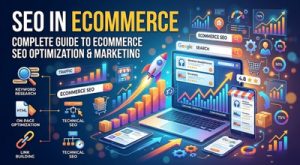
Most online stores lose potential customers not because their products are bad, but because their store never shows up when someone searches for what they sell. Ecommerce SEO closes that gap, it is the discipline of getting your product and category pages to rank so that buyers who are already searching find your store instead of a competitor’s.
This guide walks through keyword strategy, page level optimization, and the technical basics every ecommerce store needs to get right to compete organically.
What is E Commerce SEO?
E-commerce SEO is the process of making your online store more visible to the users in the search engine result page. SEO in Ecommerce helps businesses rank higher when users search for products, increasing organic traffic and sales of the business.
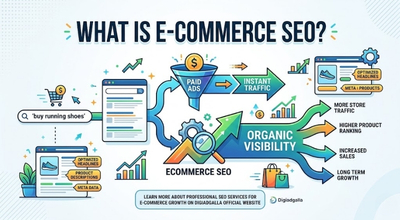
You can get traffic from paid searches as well, but SEO costs much less than paid ads. Plus, ad blockers and ad blindness reduce the effectiveness of paid ads, which makes Ecommerce SEO marketing essential for long term growth of an E commerce Business.
E-commerce SEO involves optimizing headlines, product descriptions, meta data, internal linking, and navigation structure. Each product should have a dedicated page designed to rank in search engines.
You can also explore professional SEO services for E-Commerce growth on DigiAdGalla.
Why SEO in Ecommerce is Important
E-Commerce SEO is important as:
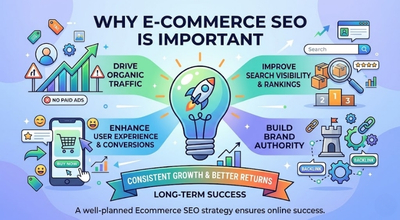
- It helps in driving organic traffic without paid ads
- Improves search visibility and rankings of the product listing
- Enhances user experience and conversions
- Builds brand authority through backlinks
Types of Pages You Must Optimize
For effective Ecommerce SEO optimization, optimize the following pages:
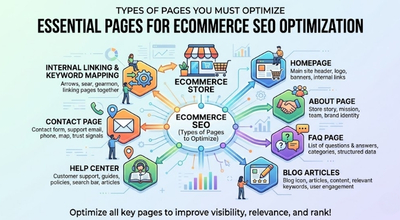
- Homepage
- About Page
- FAQ Page
- Blog Articles
- Help Center
- Contact Page
Optimizing all these pages helps improve keyword mapping and internal linking strength.
How to Develop an Ecommerce SEO Strategy
E-commerce SEO might seem like a huge task, especially if you already have a website with lots of products. It might take a lot of time, but you can speed up the process with a solid strategy, which includes:
1. Prioritize High Traffic Pages
Start with pages that already get good traffic as per your reports and observation. Optimize them further using the techniques below.
2. Create an SEO Workflow
Create a SEO workflow which includes:
- Keyword research
- Meta data optimization
- Image alt text
- Internal linking
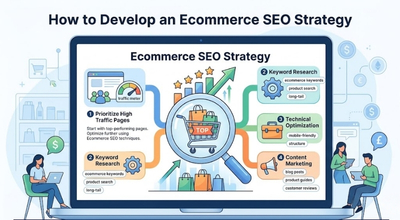
This will help you improve keyword prominence and proximity.
3. Analyze Competitors
Study your competitors closely and identify gaps or weaknesses in their E-Commerce SEO marketing strategy that you can do better.
Use tools like SEMrush and Moz to analyze competitor keywords and use them to improve your strategy.
This kind of research helps you spot opportunities your competitors are missing.
4. Combine SEO with CRO
Traffic alone is not enough. Conversion rate optimization (CRO) always ensures better results.
What is Conversion Rate Optimization (CRO)?
Conversion rate optimization is the process of increasing the percentage of website visitors that get converted to users on your site. It works along with Ecommerce SEO by turning traffic into revenue.
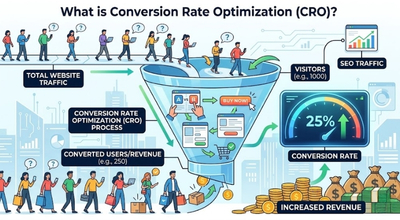
For example, if you have a 25% conversion rate, that means 25% of people who visit your website actually get converted. It is like running a retail store. Lots of people might enter and do window shopping, but leave without actually spending money.
Keyword Strategy for Ecommerce SEO
Use Primary + LSI Keywords
Include:
- Focus keyword for example – SEO in Ecommerce and
- LSI keywords like Ecommerce SEO optimization or ecommerce SEO marketing or more
Place your keyword naturally wherever the sentence calls for it, in the title, one or two subheadings, and the opening paragraph. Google has been explicit that there’s no ideal keyword density to hit, natural readability is what actually matters.
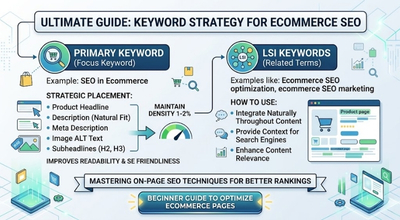
You can mention your primary keyword in your product headline, description, meta description, image alternate attributes, and subheadlines.
Use LSI keywords throughout. These are related keywords that help Google understand your page or product context.
Understand on page SEO techniques with this ultimate beginner guide to improve rankings faster and optimize your ecommerce pages effectively.
Analyze Search Volume, CPC & Intent
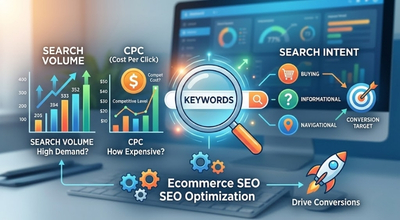
Before you use a keyword, do some research on it. Check the keyword search volume, that is how often people search for it, how competitive and how much it costs when clicked in a paid ad that is its cost per click or CPC, and what people are looking for when they use that keyword means what are they searching to buy.
Competitor Research for Ecommerce SEO
Analyze competitor’s homepage keywords, product page keywords and Landing page structure.
Your competitors are your best helpers, if we talk about large competitors in particular, they have already done their research work and have optimized their website and product listing well, you can learn many of their secrets on their websites itself.
Tools like SEMrush help identify ranking keywords and improve your Ecommerce SEO marketing approach. You can also use Moz browser extension to see the SEO title and description your competitors use in their title tags.
Don’t stop your research with keywords. Check out your competitor’s landing pages too, so you can see how they use the specified keywords to optimize those pages.
How to Index Products in Search Engines
E-Commerce stores have two basic strategies: paid ads or SEO. The most budget-friendly option is SEO, since it focuses on buyer intent rather than paid placement.
Use specific keywords like:
- “facial cream”
- “skin lotion”
Instead of broad terms like “beauty products.”
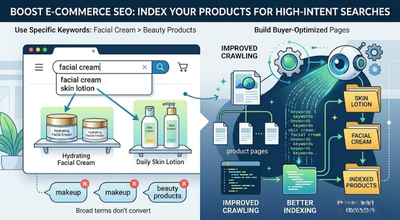
This is because SEO focuses on the products, as in most cases, people who are ready to buy search for the products they are looking for. If someone is looking for facial cream, they are not going to type “makeup” or “beauty products” into a search engine. They will type facial cream or face lotion or skin lotion or facial ointment.
For your products to show up in search results, your product pages need to be built around specific, buyer optimized keywords related to what you sell.
Learn what technical SEO is and how it helps improve crawling, indexing, and overall ecommerce website performance.
Homepage SEO Best Practices
- Title tag must be under 60 characters and written in a way that it attracts users.
- Meta description must be under 160 characters.
- Clear and focused content. No Overloaded Information. Some top sellers of your website, your USP.
Cluttered homepages can confuse visitors as well as search engines. Google will struggle to identify what you sell and who you are targeting with your products, so get specific about what your site offers. This will improve the keyword prominence and click through rates.
Keyword Optimization Techniques
Diversify Keywords
Avoid targeting the same keyword across multiple pages of your website. Each product page should focus on a different keyword. If you use multiple pages to the same keyword, you will compete with your own self and your search engine rankings will suffer due to that.
For example – If every page of your clothing E-Commerce store says, Men’s Shirts for Sale in its title, Google will think that all of your pages sell the same product.
So, give each page a specific title with a different keywords.
Avoid Keyword Stuffing
Overusing keywords harms rankings and reduces its readability. Basically, the goal is not to stuff your pages with keywords. In other words, don’t do:
“We have men’s shirts for sale. Look below for men’s shirts that are best for you. We have all sizes and colors of men’s shirts.”
Seeing the problem? It does not sound natural. Google is very good at detecting keyword stuffing, and it can seriously hurt your rankings.
Strategic Placement
Place keywords in:
- Titles
- Headers
- URLs
- Meta descriptions
- Alt text
Consider using LSIs, terms that are variations of your keywords, to avoid stuffing. If your target keyword is – Texas flag T-shirt, you can also include – Texas state flag T-shirt or Texas flag tee.
Explore local SEO services and strategies to rank your ecommerce business in specific geographic locations effectively.
Product Page Optimization
Use Proper Headings
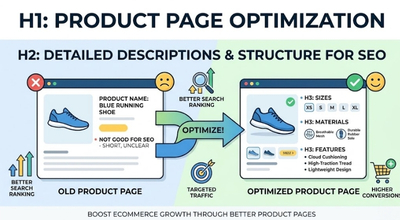
Use one H1 per page, this is how Google understands what the page is about, and it also helps maintain a clear structure.
Write Detailed Descriptions
A lot of product pages are short. Some just list the name of the product and nothing else, this is not good for SEO.
Include:
- Sizes
- Materials
- Features
Image SEO for Ecommerce
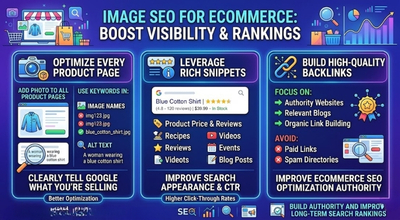
Every product page should have a photo and add keywords in:
- Image names
- Alt text
Example:
Instead of “img123.jpg,” use “blue cotton shirt.jpg”
All of these small improvements make it clear to Google what each of your product and category pages are selling.
Add Rich Snippets
Rich snippets improve search appearance and CTR.
Types of snippets include:
- Products price and reviews
- Recipes
- Reviews
- Videos
- Events
- Blog posts
As a shopper, you’d naturally be drawn to a listing with reviews, price, or ratings shown right in the search result. That said, not all of these apply to every business, choose the ones that fit your product offerings.
Fix critical errors by learning common Google indexing issues in GSC and how to resolve them quickly for better rankings.
Build High Quality Backlinks
Backlinks are created when another website links to yours. Backlinks are one of the strongest ranking signals for improving authority and search visibility. Focus on:
- Authority websites
- Relevant blogs
- Organic link building
Avoid:
- Paid links
- Spam directories
You should never buy links, exchange links, or pay to list your site in spammy directories. These types of backlinks break Google’s link quality guidelines and can ultimately decrease site rankings.
For detailed implementation, refer to Google’s SEO Starter Guide.
Rank on Potential Keywords
Use real data instead of generic tools.
Focus on Long Tail Keywords
Benefits of using long tail keywords are:
- Less competition
- Higher intent
- Better conversions
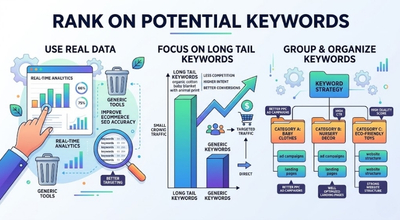
Group & Organize Keywords
Grouping and organizing keywords helps with:
- Better PPC ad campaigns – Keyword targeted PPC ads have high CTR which improves Quality score and give better ranking.
- Well optimized landing pages – If the landing page matches the ad and its keywords, it gives a better Quality Score and increases CTR
- Strong website structure
This supports content readability and SEO performance.
FAQs
1. What is SEO in ECommerce?
E-Commerce SEO is the process of optimizing an online store, its product pages, category pages, site structure, and technical setup, so it ranks higher in search engines and attracts organic, non-paid traffic. Unlike general SEO, it specifically focuses on getting individual products discovered by buyers who are actively searching to purchase, not just browse.
2. Why is E-Commerce SEO important?
It increases visibility, drives consistent organic traffic, and boosts sales without the recurring cost of paid ads. Since SEO traffic compounds over time rather than stopping the moment you stop paying, it becomes one of the most cost-efficient long-term growth channels for an online store.
3. What is E-Commerce SEO optimization?
Ecommerce SEO optimization includes improving product pages, keywords, and technical SEO to boost rankings.
4. How does SEO in Ecommerce work?
Ecommerce SEO marketing uses keyword strategies, content, and backlinks to drive organic growth.
5. What are LSI keywords in ecommerce SEO?
LSI keywords are variations to the keywords that help search engines understand your content better and avoid keyword stuffing.
6. How can I avoid keyword stuffing?
Place your keyword naturally where the sentence calls for it, in the title, one or two subheadings, and the opening paragraph instead of targeting a percentage. Google has confirmed there is no ideal keyword density. What matters is natural readability.
7. What are long tail keywords in E-Commerce SEO?
They are longer, specific phrases with lower competition and higher conversion rates.
8. How long does ecommerce SEO take to show results?
E-Commerce SEO typically takes 3 to 6 months of time to show results depending on its competition and your strategy.
Conclusion
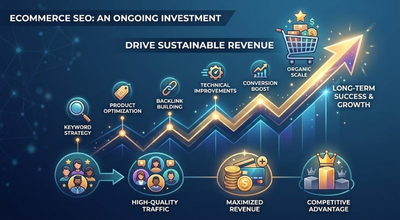
SEO in Ecommerce is an ongoing process that requires consistency and strategy. From keyword research and product page optimization to backlinks and technical improvements, every step contributes to better rankings.
By implementing strong Ecommerce SEO optimization and a data driven Ecommerce SEO marketing strategy, you can drive high quality traffic, improve conversions, and grow your online store for the long term.
In the long run, SEO becomes one of the most valuable investments for any E-Commerce business looking to scale organically and stay ahead of competitors.
Understand the digital marketing funnel and its powerful stages to boost ecommerce conversions and maximize revenue growth.