If you’ve ever wondered why some websites show up on the first page of Google while others stay buried on page five, the answer is almost always SEO.

This guide breaks down what SEO actually is, how it works behind the scenes, and what it takes to start ranking your own website, without the vague buzzwords that usually surround this topic.
What Is SEO?
SEO stands for search engine optimization, the ongoing practice of shaping a website so that Google and other search engines can find it, understand it, and show it to the right people. In plain terms, SEO is what determines whether your business shows up when someone searches for what you sell, or whether a competitor shows up instead.
Unlike paid ads, SEO does not involve paying a search engine directly for placement. Instead, it works by aligning your website’s content, structure, and reputation with what search engines look for when deciding which pages deserve to rank. Done well, SEO brings in visitors who are already looking for what you offer, without an ongoing per-click cost.
By the end of this guide, you will understand what SEO actually involves, why it is worth the investment, and how to start applying it to your own website.
How Does SEO Actually Work?
Search engines like Google use automated programs, commonly called crawlers or bots, to scan the web and collect information about pages. Google keeps all of that information in a huge, constantly updated database it calls an index. When someone types a search query, Google’s ranking systems sort through the index and return the pages judged most relevant and most trustworthy for that specific query.

SEO is the work of influencing that judgment in your favor. It generally breaks down into three interconnected pieces:
- Relevance. Does your page actually answer the question the searcher is asking?
- Authority. Do other credible sources treat your page as trustworthy, usually signaled through links and mentions?
- Experience. Is the page fast, mobile-friendly, and easy to use once someone lands on it?
No single factor guarantees a first-page ranking. Search engines weigh hundreds of signals together, and those signals shift over time as search engines refine how they evaluate quality. If you want to understand how this plays out across an entire customer journey rather than a single page, our guide to the digital marketing funnel walks through where SEO fits alongside other channels.
The Four Main Types of SEO
Most SEO work falls into one of four categories, and a solid strategy usually touches all four.
1. On-page SEO covers everything you control directly on a page: the title tag, headings, body content, internal links, and image alt text. This is where keyword research and content quality live. If you are just starting out, our on-page SEO guide for beginners breaks this down step by step.
2. Technical SEO covers the behind-the-scenes structure of a site: how fast it loads, whether Google can crawl it properly, whether it is mobile-friendly, and whether the site’s code follows best practices. We go deeper into this in our breakdown of what technical SEO actually involves.
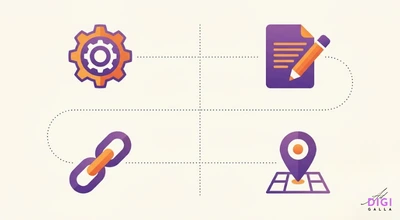
3. Off-page SEO covers signals that happen away from your own site, most notably backlinks from other websites. A link from a trusted site works like a vote of confidence, telling search engines your page is worth referencing.
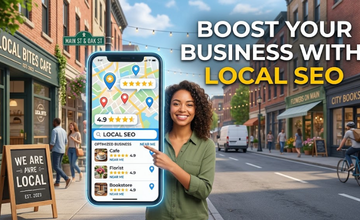
4. Local SEO covers the specific tactics that help a business show up in local search results and map listings, such as a complete Google Business Profile, consistent business information across the web, and location-specific content. Understanding local search intent matters here, since ranking for the right local queries matters just as much as ranking for high-volume national ones.
A website that is strong in one area but weak in another will usually underperform. A page with excellent content on a slow, poorly structured site will still struggle to rank.
Why SEO Matters for Your Business
Search is often the first place people go when they have a need, whether that is finding a local service, comparing products, or researching a decision. A business that is not visible in those results is, for practical purposes, invisible to a large share of potential customers.
Unlike paid ads, SEO keeps working in the background, a page you optimize today can keep bringing visitors long after you’ve moved on to other work. That does not make SEO free. It takes real time, content, and technical work, and results build gradually rather than overnight.

It is also worth being clear that traffic by itself is not the goal. As we explain in why traffic alone never grows a business, visitors only matter if they are the right visitors who go on to enquire, buy, or return. For most businesses, the realistic goal is not a single #1 ranking but a growing footprint of pages that collectively bring in relevant, converting traffic across different searches your customers are already making.
SEO and Page Experience: What Core Web Vitals Have to Do With It
Search engines do not only look at content. They also evaluate how a page performs once someone actually opens it. Google measures this through a set of metrics called Core Web Vitals, which look at loading speed, responsiveness, and visual stability.
According to Google’s own Search Central documentation, a page should aim for Largest Contentful Paint within the first 2.5 seconds of loading, an Interaction to Next Paint of less than 200 milliseconds, and a Cumulative Layout Shift score below 0.1. Pages that miss these marks by a wide margin tend to frustrate visitors, and Google has said that page experience feeds into its core ranking systems alongside content relevance.

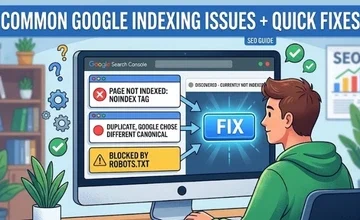
In practice, this means SEO is not purely a writing exercise. A beautifully written page on a slow, unstable website is still fighting an uphill battle, and if pages on your own site are not showing up in search at all, it is worth checking for common Google indexing issues before assuming the content itself is the problem.
A Hypothetical Example of SEO in Action
To show how these pieces come together, here is a hypothetical example based on patterns commonly seen in SEO work, not a real client case.
Imagine a small home décor and furniture brand in Delhi NCR that sells online. For two years, the brand relied entirely on paid social ads to drive sales. Its blog sat untouched, product pages had thin, duplicate-sounding descriptions, and large unoptimized images meant the site loaded slowly on mobile, the device most of its shoppers actually used.

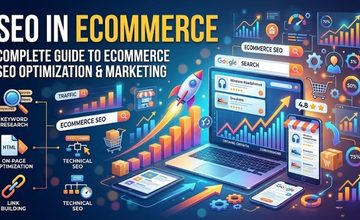
A typical SEO process for a business like this would start with a technical audit to fix page speed and mobile issues, since a slow site undermines everything else. From there, the work would move to rewriting product and category pages with real, specific descriptions instead of generic copy, following the kind of on-page SEO fundamentals covered here, and building out buying-guide content that answers the questions shoppers actually search before purchasing, an approach we cover in more depth in our e-commerce SEO guide.
A business following this kind of approach would typically expect organic visibility to build gradually over four to six months, as new and improved pages get crawled, indexed, and start earning trust, rather than any overnight jump. This is illustrative only. Actual timelines and results vary by industry, competition, and starting point, and no legitimate SEO service can honestly promise a specific ranking or number.
Common SEO Myths That Waste Time and Budget
“SEO is a one-time setup.” SEO is ongoing. Search engines update their systems constantly, competitors keep publishing content, and a site that was optimized two years ago can slip without maintenance.
“More keywords always means better rankings.” Repeating a phrase unnaturally throughout a page, often called keyword stuffing, tends to hurt readability and can work against you rather than for you.

“SEO and paid search are the same thing.” They are related but distinct. SEO builds organic, unpaid visibility over time, while running ads through a platform like Google Ads buys immediate placement for as long as the budget lasts.
“Any content will do, as long as it has the right keyword.” Search engines are increasingly good at distinguishing genuinely useful content from thin content built purely to target a phrase. Depth and accuracy matter, which is also why it pays to understand why so many businesses end up wasting their marketing budget chasing tactics instead of strategy.
How to Get Started With SEO
- Start with keyword research to understand what your potential customers are actually searching for.
- Audit your website’s technical health, including load speed and mobile usability.
- Build out content that directly answers the questions your audience is asking, following a structure similar to how we approach writing a blog post.
- Set up and maintain a complete Google Business Profile if you serve customers locally.
- Track your progress with a tool such as Google Search Console rather than guessing.

Businesses that are short on time often bring in a marketing partner to handle this work end to end. If that is where you are, our search engine optimization services and broader digital marketing services cover exactly this, from technical fixes to ongoing content and local strategy.
Frequently Asked Questions
1. What is SEO in simple terms? SEO is the practice of improving a website so it shows up higher in unpaid search results. It combines content quality, technical performance, and outside credibility signals like backlinks to help search engines understand and trust a page.
2. How long does SEO take to show results? Most businesses start seeing meaningful movement within three to six months, though this varies widely by industry and competition. SEO is a compounding, long-term effort rather than an instant fix, and anyone promising guaranteed overnight rankings should be treated with caution.
3. Is SEO free? There is no fee paid directly to search engines, but SEO still requires real investment in time, content creation, and often technical work or professional help, so it is not free in a practical sense.
4. What is the difference between SEO and SEM? SEM, or search engine marketing, is the broader category that includes both SEO and paid search advertising. SEO focuses on organic rankings, while paid search, such as Google Ads, buys visibility for as long as a campaign runs.
5. Do I still need SEO if I already run paid ads? Yes. Paid ads stop generating traffic the moment spending stops, while SEO builds visibility that continues working over time. Many businesses use both together for short-term and long-term visibility.
Final Thoughts
SEO is not a trick or a shortcut. It is the ongoing work of making a website genuinely easier for search engines to understand and genuinely more useful for the people who land on it. Businesses that treat it as a real, continuous practice, rather than a one-time task, tend to see the most durable results.
If you are building or refining your own SEO strategy and want hands-on support, DigiAdGalla works with businesses across Delhi NCR on the full range of SEO, from technical audits to content and local visibility. You can see our full range of work on the services page or get in touch directly.